Showing posts with label Informational Writing. Show all posts
Saturday, February 9, 2019
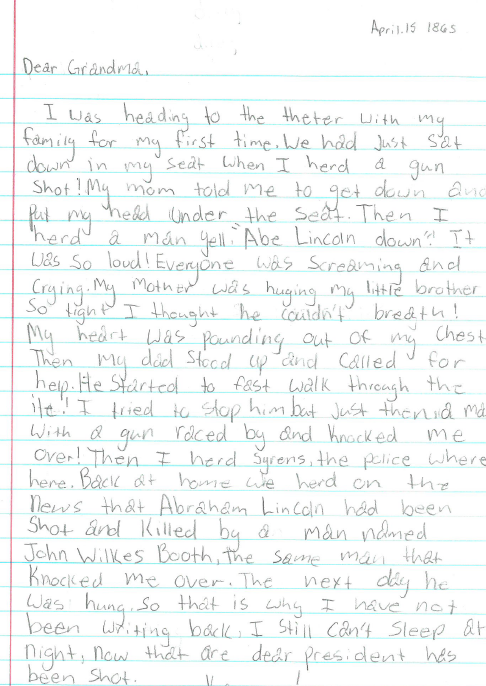
Civil War Era Diary Entries or Notes Home
Students worked on a diary entry or a "letter home" to show their understanding of a Civil War era idea. Below are some examples demonstrating their understanding (and misconceptions) of the historical content.
Sunday, November 26, 2017
What's the Big Idea?
Students will be transitioning to Informational writing in the next trimester. It is important for them to be able to identify an important idea and the details or evidence from the text that supports that idea.
Working with a graphic organizer from Jim Burke's book Reading Tools, Tips, and Techniques students listened to me read about two famous scientists.
Then, students chose their own text and worked to find the most important idea about these groundbreaking people.
Working with a graphic organizer from Jim Burke's book Reading Tools, Tips, and Techniques students listened to me read about two famous scientists.
The first reading was for listening only. The second reading, students had their own text to follow along. They were encouraged to annotate the text as I reread the text. Using a shorter piece of text helped keep the lesson focused. This is the book where I focused on two individuals.
Then, students chose their own text and worked to find the most important idea about these groundbreaking people.
These books have great stories about overcoming great odds. Each text highlights an individual who accomplished great things under extraordinary circumstances!
Friday, December 4, 2015
Ready, Set, Write! Informational writing
Students listened to how we "stop and jot" as we read informational text. This will help us as we collect information for our writing piece.
Students highlighted a writing goal that they identified after
reviewing their first draft. What is going well? What is missing?
Let's focus on a goal that pushes us to think about elaboration or the craft of writing.
Students work to enhance the first draft. Collect more notes, add quotes,
details, ideas from taking more notes.
Cut that first draft apart. Make changes and revisions.
Add more detailed information. Use more content focused vocabulary.
Working so hard cutting and crumpling up wads too!
Subscribe to:
Comments (Atom)