Showing posts with label Math Fractions. Show all posts

Thursday, November 18, 2021

Fraction Action!

 Students are knee-deep with fractions. When you say Fractions, even many adults admit that they "hate" fractions. Yet, teaching fractions has provided some of my most joyful teaching days in math!

A wonderful Colleague introduced me to this post by Graham Fletcher:


Below, you can see how students talked through the points on the number line.

I was pretty impressed. You can see that my first "B" was not really centered at the 1/2 mark (really the second one is not great either!) and students originally noted 3/8. When the student explained why it was 3/8 vs. 4/8, I knew that I needed to redraw my 1/2 mark for the rest of the conversation to move forward.


The number line was presented in purple. The annotation in pink marker shows the kids' thinking.


This string was fun! Students recognized the pattern of the half from the previous string becoming the endpoint for the next string. In other words, we kept narrowing in on the values between the half and the whole.


We have also started many lessons by thinking about how we can label fractional parts and how they are equivalent to other parts.
I highly encourage you to try these with your students as they were informative and built conceptual knowledge along the way!

Students shared their ideas:


Here is another example where students 
shared their thinking:

Original:


I loved the green outline of the quadrilateral that was 3/8. I did not see that one!


Wednesday, May 8, 2019

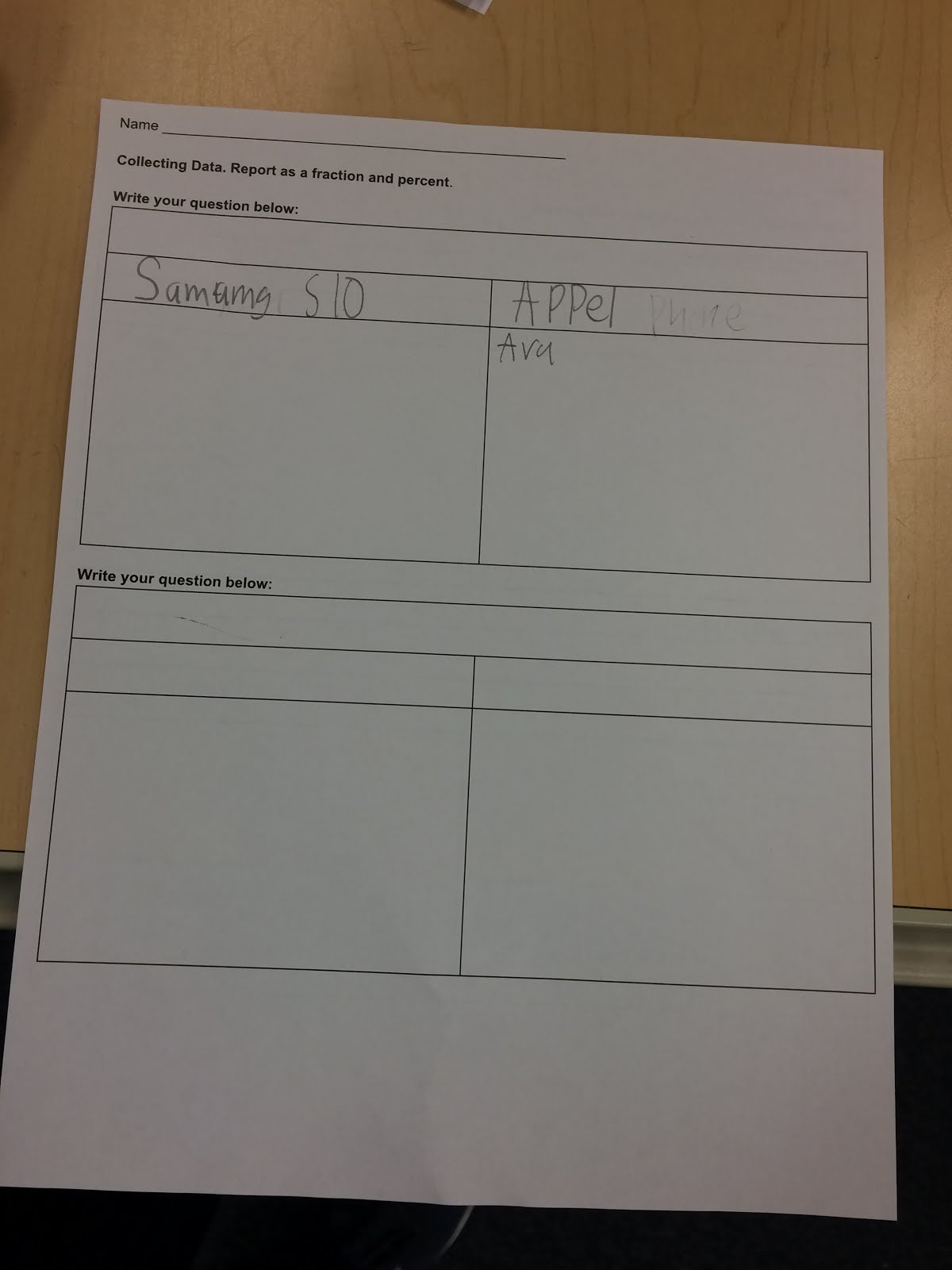
Collecting Data and Formulating Percents!

Students developed a question that they could survey their classmates on to collect data.  Today was perfect for representing the data into a percent as we had exactly 20 students present today!  Students started with the question...


Some people went a tad dark...

Then students represented how many were in favor or not in favor with percents!  Students really enjoyed this activity and saw a purpose for using math!

Wednesday, January 25, 2017

Modeling Mixed Numbers

Students were asked to construct a model of one and three-fourths using math tools or by making a drawing.


 Students use a circle model to show 1 3/4. 
 Here you see a dozen of donuts, with 12 being how many parts in the whole.

Students were given a mixed number that they had to model on a poster for the rest of the class to guess. They could not represent the mixed number using symbols or numbers.  Many students noticed that it was important to define the whole and how many parts made the whole.

Next, students worked to match a model with a mixed number and its corresponding improper fraction. 

Students revisited the different combinations made throughout the math session to generate a "rule" on how to convert a mixed number into an improper fraction and vice versa!

Thursday, January 14, 2016

Roll Around the Clock

Roll Around the Clock is a context from the Investigations book Name that Portion.

Students are solving fraction addition problems by using the clock as a model. This model is helpful when working with fractions involving 1/3, 1/6, and 1/12.  


In order to solve some of the addition problems, students need to find a common denominator (6 or 12) to support with solving the problem.  This experience also reinforces the relationship of equivalent fractions and representing a fraction in the lowest term.


Thursday, December 17, 2015

Fractions!

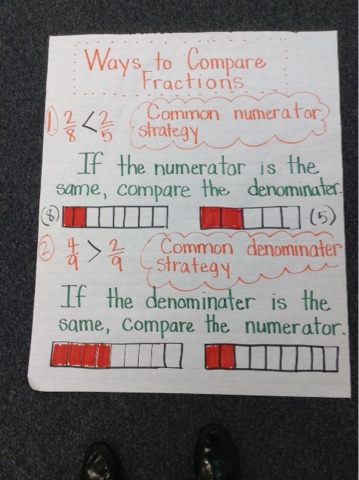
Students are working on fractions! We will spend the next few days building a variety of ways that we can compare fractions. Our first two approaches are to:
Students are creating some tools to support them with comparing fractions visually. They also arranged some fractions to show how they are equivalent to other fractions.

Using Fosnot's Best Buys resource, students are introduced to a real-world context. Purchasing cat food from two different stores. Which store has the best buy? How do you know?

Students work collaboratively to solve the problem and to share a variety of ways of how to approach the question. Finally, each group prepared a poster that will initiate our math congress tomorrow during math.